FEDAS annual conference 2006 in Naples:
Fighting product piracy - Factory outlets and mono-brand stores of the partners from industry
trouble long-standing distribution partnerships
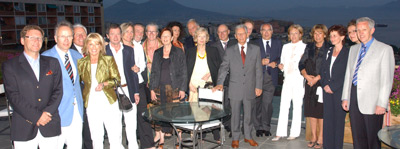
Participants in the Fedas Annual Meeting 2006 in Naples
Naples – “We from Fedas turn vigorously against product piracy, which is growing in all areas of supply, and which does not spare our sector either. Not only have the corresponding legal regulations to be tightened, but also the related controls on all levels. Only in this way can we guarantee that purchasers of sports goods and sports fashion will actually receive branded goods of a quality that lives up to their prices. With its offer the European specialist retail trade makes a substantial contribution to keeping the market free from such counterfeits. As regards the supply of cheap competitors, this need not necessarily be the case.” With these words, Fedas President, Werner Haizmann from Stuttgart and secretary general, Claude Benoit, addressed one of the European retail trade’s most pressing problems at the Annual Meeting of Fedas, the European umbrella organization of the specialist sports goods trade, which was held in Naples at the end of May.
In his statement, Fedas President, Werner Haizmann, who is also President of the German retailers’ association, VDS, first of all mentioned the specialist sports trade’s pleasing sales development in Europe. Due to a good winter season and sales achieved in the wake of the Soccer World Cup, this development is very positive, and it is hoped that it will persist until the end of 2006 and even beyond.
As before, common work on developing the Fedas product classification key further is one of the federation’s flagships. Mr Haizmann presented his special thanks to secretary general, Claude Benoit, who is also President of the Swiss partner association Asmas, and who did an excellent and pioneering job together with his team of experts. “All Fedas member associations are proud to see that the Fedas product classification key can no longer be done without in our sector’s data processing operations. We from Fedas have thus created our own, unmistakable electronic product bible.”
Fedas is still very pleased to see that the European specialist sports goods trade has the world’s largest and most traditional trade show at its disposal: ispo in Munich, which is held in Summer and in Winter. The German association, VDS, godfathered the show’s foundation. “We have strongly promoted this show ever since the establishment of our association; we have done so not only in our own interest, but because we are all proud to accommodate the world’s best specialist sports goods show right in the heart of Europe. We are, however, still unable to understand why long-standing brand-name partners, who owe their success not least of all to the European specialist sports goods trade’s consistent work, retire from this world event, above all from its Summer edition. In contrast, we are even more delighted to note that there are still outstanding medium-sized businesses using ispo as an excellent platform for their sales channel, the specialist retail trade. We would therefore like to thank our fair partners in Munich for all major marketing activities supporting the appearance of these businesses. We at Fedas will invest all our energies and continue in promoting the world show ispo as being the unique important meeting place of the sector in our globalized branch of business.” Such was the comment given by Fedas President, Werner Haizmann, and Fedas secretary general, Claude Benoit, on the federation’s viewpoint on the theme of “trade show”; they were much applauded by the audience.
At the annual meeting, which was perfectly organized by the Italian association Federadas spearheaded by its members Enzio Pisapia, Hans Hellweger and Enrico Rossi, it was pointed out that for many years, Fedas members have had to face increasing trends towards concentration not only as regards the industry, but also on the trade’s side. President Werner Haizmann said that, “Being a trader, we could be happy about that situation. After all, it proves that it is not possible to do without multi-label specialist stores when distributing sports goods and sports fashion on a large scale; and our members own a wealth of such stores. This is a weapon that should not be underestimated in our struggle against the rising trend on the part of our partners from the industry to offer their branded goods in their own mono-brand stores thus avoiding the retail trade.
It is especially from the ranks of the big players that we can hear announcements saying that they wish to attain own retail sales amounting to 10 to 15 per cent of their overall turnover in the near future. With a concentration on the big suppliers, however, the situation of smaller and medium-sized sports shops in Europe is getting ever more critical. For instance, on the side of the trade five national or international supplier groups alone account for more than 50 per cent of the entire European sales in the specialist trade, i.e. approx. Euro 37bn. Moreover, 90 per cent of these specialist retail sales in Europe are recorded in six countries. In Germany alone, the Top 5 of the specialist sports retail trade ranking account for 93 per cent of the overall turnover of approx. Euro 7 billion. Of these, 53 per cent are held by Intersport Germany alone. In France and Italy, Decathlon dominates the scene with 31 and/or 20 percent. This means that the forms of supply and of concentration differ substantially in France and Germany. As far as sales increases in the retail trade are concerned, Spain headed the list in2005 accounting for a growth of more than four per cent, followed by the UK and France.”
Commenting on the theme of “pan-European prices”, President Haizmann and secretary general Benoit once again demanded better purchasing conditions. “We do not want to demand uniform European prices for the industry, which would, after all, be appropriate for the economic area of the 25 EU countries and Switzerland uniting more than320 million consumers. Nevertheless, we have to do all we can to ensure that we, as the European specialist sports goods trade, receive better purchasing conditions than before. The tenacity of this problem may be considered evidence of the big brand-name suppliers’ desire to participate strongly in the European market with their own stores. They keep talking about growths in sales and profits of more than ten per cent per year. On the other hand, we as the sports retailers, have to accept low single-digit growth rates, if any at all.”
As before, Fedas will continue to push back the growing influence of genuine and false factory outlets in Europe. At the same time, the federation wants to observe closely how the turnover relationship between the industry brands on the one hand, and the trading groups’ exclusive brands on the other hand will continue to develop over the next few years. Decathlon, for instance, is offering 50 per cent of own brands in France already, while Intersport in Germany records 17 per cent of its sales with such products. “Here we have to ask what is our position as a specialist retailer and that of our sales strategies: do we prefer strong national or international industry brands boasting a good image and a low margin, which frequently compete with us through their own stores; or will our sales focus more strongly on the exclusive brands of our trading groups promising excellent gross margins and offering the consumer a high utility value and a good price-performance ratio?” With these words, Werner Haizmann concluded his statement. His presentation was complemented with the business reports of the individual Fedas member countries and a glance at the developments on their respective markets. As far as the VDS is concerned, the association’s secretary, diploma sports economist Jens Forstmann highlighted the VDS’s work and outlook in a PowerPoint presentation for the first time. His colleagues provided a warm welcome to the new expert from Germany.
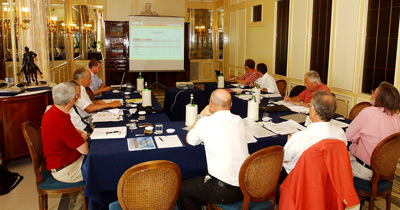
The delegates during the session